SQL Temporal Tables
SQL Temporal Tables is a feature that allows you to keep a history of changes to a table without an effort. By enabling SYSTEM_VERSIONING on a table, SQL...
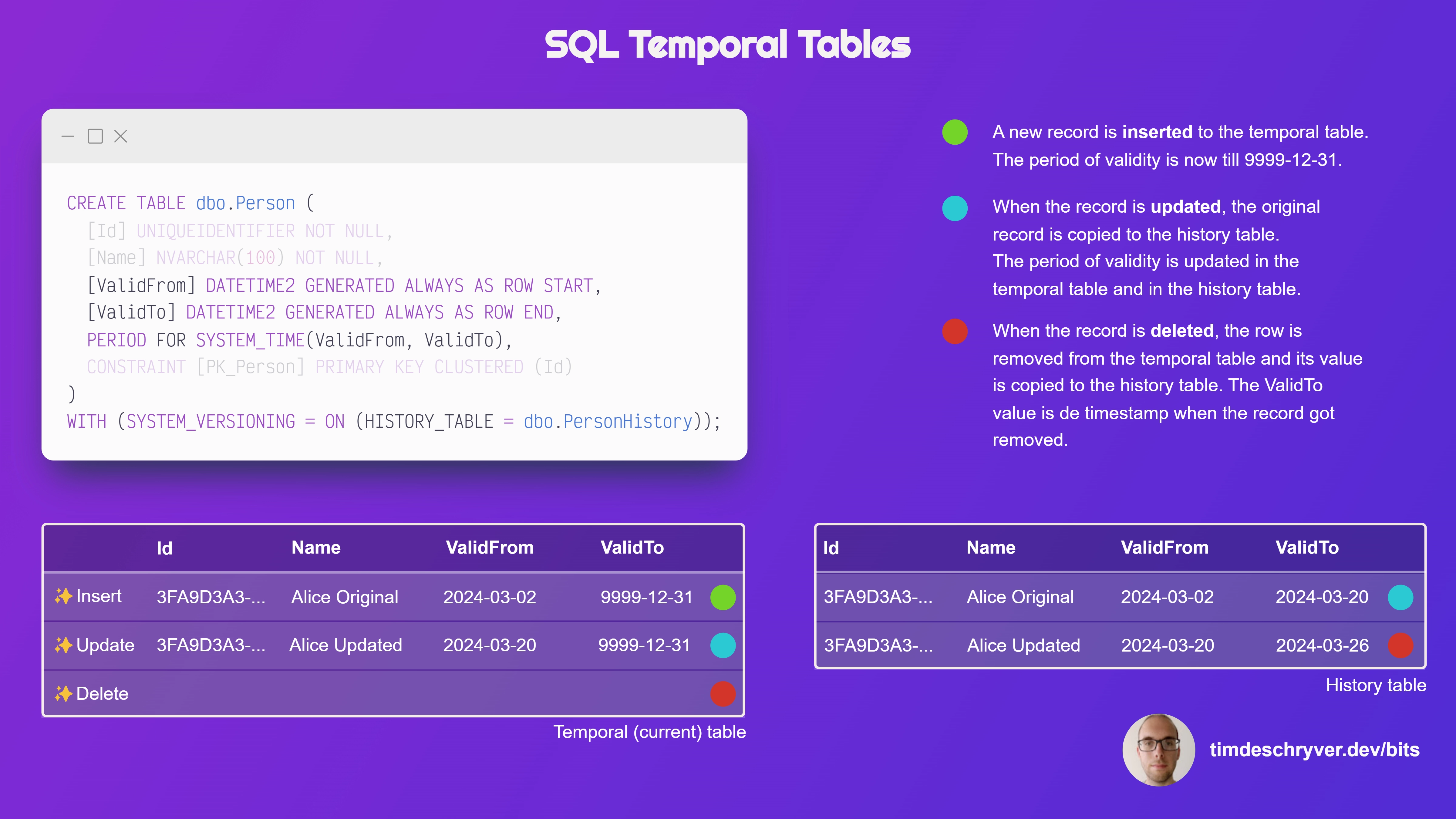
SQL Temporal Tables is a feature that allows you to keep a history of changes to a table without an effort.
By enabling SYSTEM_VERSIONING on a table, SQL Server creates a history table and keeps track of changes to the table.
This is useful for auditing purposes, or for tracking changes to data over time.
Temporal tables (also known as system-versioned temporal tables) are a database feature that brings built-in support for providing information about data stored in the table at any point in time, rather than only the data that is correct at the current moment in time. Because it keeps a full history of data changes, it allows for easy point-in-time analysis.
This is useful for:
- Auditing all data changes and performing data forensics when necessary
- Reconstructing state of the data as of any time in the past
- Recovering from accidental data changes and application errors
- Insights to data trends
For more info see the documentation.
Temporal tables are supported by Entity Framework, as I've mentioned in my blog post Entity framework features I wish I knew earlier.
Feel free to update this developer bit on GitHub, thanks in advance!