New in Entity Framework 8: Primitive collection properties
Starting from EF 8, EF automatically stores a collection of primitive values directly in a column (as JSON), whereas previously a separate table was required.
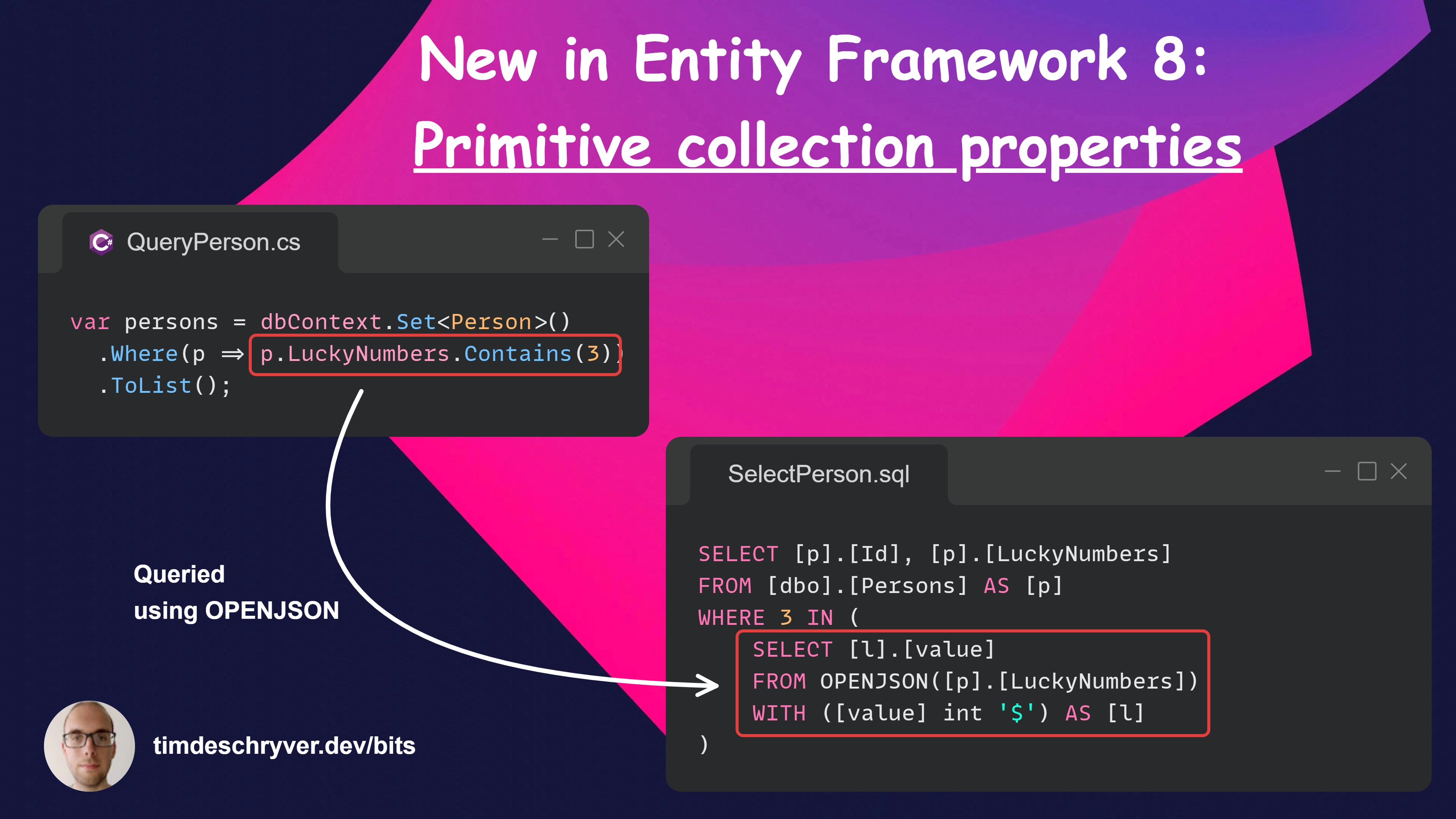
Starting from EF 8, EF automatically stores a collection of primitive values directly in a column (as JSON), whereas previously a separate table was required.
To query data, the OPENJSON table-valued function is used. This creates a rowset view of the JSON data, which can be compared as a "normal" relational table, and can thus be queried as you're used to.
OPENJSON is more and more used in EF features to support more use-cases (or to improve the query performance). An example of this is the possibility to use inline collections while querying data, as mentioned in the release announcement.
A use case for using primitive collection properties is to save a data collection that's retrieved via its parent. If you need to query this set, it's probably better to store the collection in a seperate table. This allows you to create indecies in order to optimize search-based scenarios, that otherwise isn't possible using a JSON column.
Let's explore how this translates into code and SQL.
For more info and new features introced in EF 8 see the documentation.
Feel free to update this developer bit on GitHub, thanks in advance!